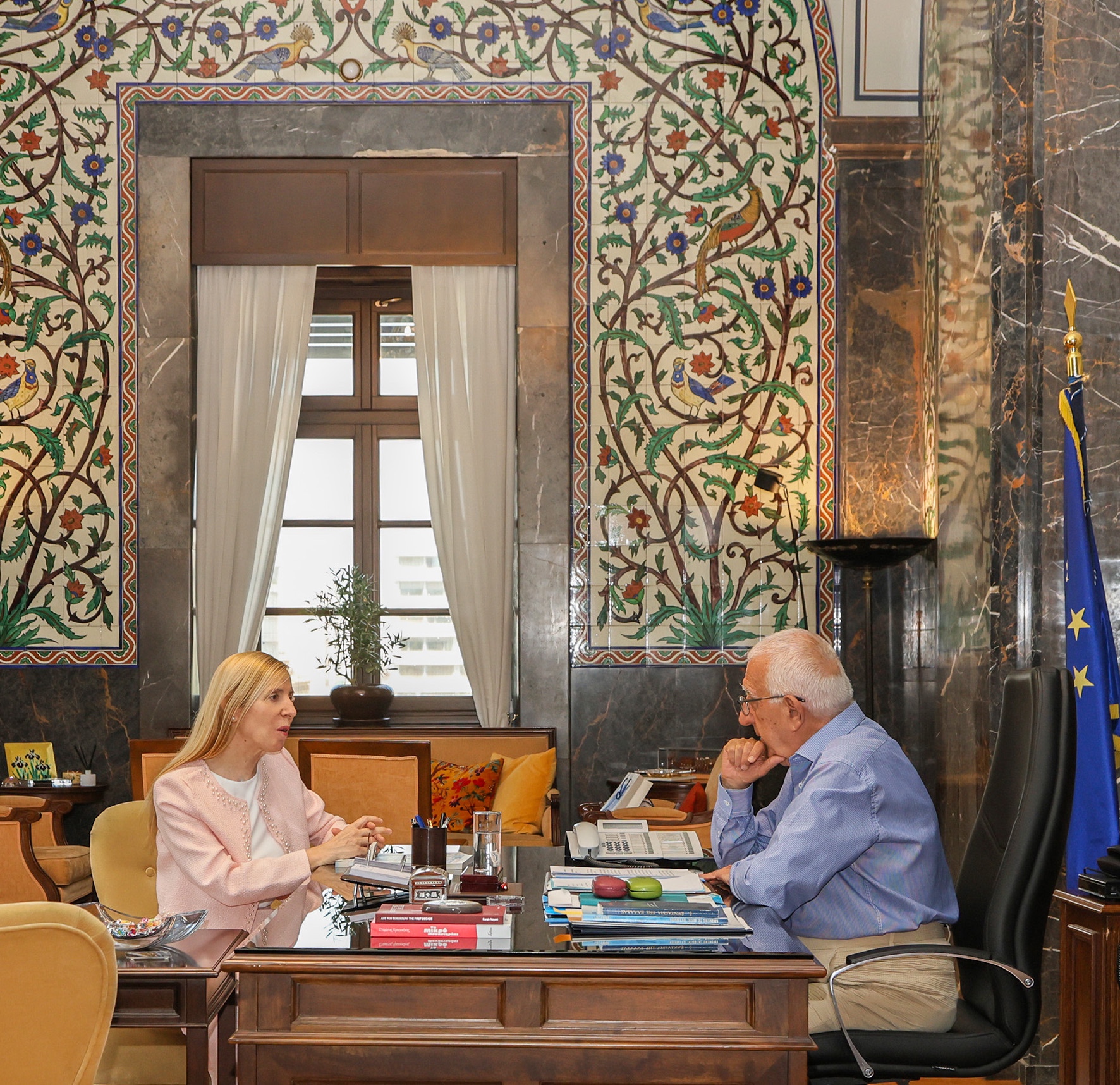
By Dr. Martha Theodorou
Mr President, how would you characterise the work of the Hellenic Parliament during the current parliamentary term? What do you consider to be the Parliament’s priorities today?
The Hellenic Parliament, during the current parliamentary term, is fulfilling a complex and particularly important institutional role. Parliament is not merely the place where laws are passed; it is the foremost democratic institution through which the will of the people is expressed, a forum where different views meet and common ground is sought in the interests of society.
Having had the opportunity to compare today’s Parliament with the Parliament to which I was first elected in 1990, I can say that much has changed. At that time, there were four political parties in Parliament: PASOK, New Democracy, the then Coalition of the Left and Progress—there was no SYRIZA at the time—and the Communist Party of Greece (KKE), with the political figures of that era. And that is significant.
I am referring, for example, to the eloquence and distinctive style of Charilaos Florakis, who brought a particular tone to the chamber; Andreas Papandreou, Giannaros, Kyrkos, Farakos and Peponis, and, on the other side of the political spectrum, figures such as Georgios Rallis, Panagiotis Kanellopoulos, Evangelos Averoff and Konstantinos Mitsotakis.
That is why, in the immediate period ahead, we are proceeding with amendments to the Rules of Procedure of Parliament, which were drafted 40 years ago, during the presidency of Giannis Alevras, by Aristovoulos Manesis, a towering figure in the field of legal scholarship.
Today’s Parliament operates in a different environment, with much greater demands for transparency, speed of information and direct communication with citizens. In this new environment, technology, social media and the mass media have changed the way in which political activity is conducted.
Unfortunately, the public usually sees the less favourable side of Parliament through the media. When we exchange a few “French expressions” among ourselves, it becomes headline news across all television channels. When serious contributions are made by Members from all political parties, they receive little or no coverage; and if they are reported at all, it may be no more than a brief newspaper item.
At the same time, citizens have developed a stronger demand for accountability, as the way in which they follow and assess parliamentary activity has also changed.
In what ways can the President of Parliament further enhance the quality of the legislative process?
As President of Parliament, my role is primarily institutional. That means acting as a guarantor of the smooth functioning of the parliamentary process, respect for all views, and the substantive consideration of legislative initiatives.
As regards the quality of legislation, which you referred to, it does not depend solely on the passage of a law, but also on whether it has been preceded by substantive dialogue, consultation with social stakeholders and the utilisation of scientific expertise.
In this context, every initiative that contributes to a more organised and effective functioning of the Plenary and the Parliamentary Committees is important.
The so-called speaking-time limit in the Plenary was an effort to manage parliamentary time more effectively, so that more Members would have the opportunity to take the floor and the debate could become more substantive and productive. In practice, it appears to have worked, judging by the reactions of almost all Parliamentary Groups.
What contribution do Parliamentary Committees make to improving the legislative process?
Parliamentary Committees constitute one of the most important pillars of the legislative process. It is there that specialised dialogue takes place, legislative initiatives are examined in detail, and representatives of society have the opportunity to participate.
The participation of scientific, social and productive-sector bodies provides valuable expertise and helps ensure that the laws adopted respond more effectively to society’s actual needs. It strengthens dialogue and, above all, helps move beyond narrow party lines.
How can Parliament become even more open and accessible to citizens? In what way can Parliament’s digital transformation make a meaningful contribution to transparency and to keeping citizens better informed?
In 2026, Parliament cannot be confined solely to the Plenary and the Committee rooms and be regarded—as I mentioned earlier—only as the place where laws are debated and passed. It must be an open institution, a living organisation, with a duty to remain connected with society, culture, education and the needs of citizens.
For this reason, making Parliament more outward-looking has been one of my key priorities from the very beginning of my term in office.
A series of initiatives forms part of this effort, aimed at highlighting Parliament’s different social and cultural dimension. The utilisation of the former Tobacco Factory as a venue for culture, education and public dialogue is the clearest example of a Parliament opening its doors to society.
At the same time, a number of initiatives have demonstrated that Parliament can also serve as an institution of culture. The honorary event dedicated to the great Greek creator Stavros Xarhakos was a distinctive moment—a symbolic yet substantive initiative that brought culture into the heart of our democratic institution and offered citizens a different image of Parliament.
At this point, I would also like to refer to Parliament’s social dimension, which is not particularly well known to the public. In recent years, a systematic effort has been made to support organisations and institutions that perform important work for society and the country.
Through donations funded from Parliament’s budget, we provide practical support to hospitals and universities by supplying modern equipment for their needs; we support institutions that make a meaningful social and charitable contribution; and, above all, we stand consistently alongside persons with disabilities and vulnerable social groups.
Parliament is also moving decisively forward with its digital transformation, making use of new technologies—particularly artificial intelligence—with the aim of ensuring that every citizen can have easier and more direct access to what is happening in Parliament.
Indeed, Parliament is the first public institution to have joined this major national effort to harness the country’s artificial-intelligence infrastructure.
At the same time, among other initiatives, we are advancing the training of Parliament’s human resources through cooperation with leading academic institutions, such as the National Technical University of Athens.
Public trust in institutions is an issue of fundamental importance. What role can Parliament play in strengthening citizens’ trust in institutions?
Trust in institutions has to be earned every day. Citizens want to see a Parliament that listens, engages in debate, is accountable and delivers results with the public interest at its heart.
Strengthening trust, however, requires the existence of a political culture—a quality that, in our time, appears to be increasingly lacking.
There is a difference between political confrontation based on arguments, as was the case during the early years of my political career, and the situation today, which in a number of cases goes beyond acceptable limits.
Do you believe that public parliamentary debate adequately responds to the needs and expectations of society?
As I have mentioned, political disagreement is necessary in a democracy. Diversity of views is the objective, not the problem.
Over the years since my first election in 1990, the way in which political debate is conducted has also changed significantly. The pace is faster, public exposure is greater, and society’s expectations are higher.
Strong political confrontation is entirely legitimate, but it must not lead to the devaluation of Parliament.
The measures being introduced—including the forthcoming amendments to the Rules of Procedure of Parliament, which will also provide for stricter penalties—serve precisely this purpose: to organise debate in the Plenary more effectively, with the aim not of restricting freedom of speech, but, on the contrary, of ensuring that parliamentary dialogue remains vibrant, substantive, non-toxic and fair to all.
Given your knowledge of the role and work of the Economic and Social Council of Greece, how would you assess its contribution to parliamentary work?
The Economic and Social Council of Greece (ESC) is a particularly important institution of social dialogue. Its value lies precisely in its ability to bring together different social and productive-sector voices and convey them, in an organised and well-substantiated manner, into the public debate.
As I mentioned during our recent official meeting, the contribution of the Opinions issued by the ESC to the preparation of legislation is extremely important, given the particularly broad range of subjects covered by the Council’s advisory work.
Its contribution is particularly valuable because it brings the perspective of society and the economy into the decision-making process.
For this reason, I am confident that cooperation between Parliament and the ESC can contribute to ensuring that legislation more effectively reflects the current needs and challenges facing Greek society.
In which areas can the ESC’s composition, institutional experience and expertise provide particular added value to parliamentary work?
Social cohesion, addressing demographic challenges, employment, economic growth, the green transition and the digital transformation are, I believe, important areas in which the ESC can make a substantive contribution, drawing on its role and its many years of experience.
After all, the participation of the social partners in public dialogue is an important asset for our democracy.
If you were asked to sum up in one phrase the institutional legacy you would like your term of office in the Hellenic Parliament to leave, what would it be?
I would like to leave as my legacy a Parliament that is more outward-looking, more modern, more open and closer to the citizen.